Q. Your Space for Visualisations
AI-generated image
Open Call: Science Visualisations
Virtual Reality/3D LED-CAVE
In 2027, Q. will open in the heart of Vienna, where science meets the public. As part of this call for entries, we invite you to bring your scientific visualisations to life in a truly impressive way using our CAVE system.
We welcome submissions from the natural sciences, social sciences, humanities and engineering disciplines of the organising institutions: TU Wien, the University of Vienna and the Austrian Academy of Sciences. We are looking for visualisations of existing scientific data, models or processes. The aim of this call is to adapt existing scientific visualisations so that they can be presented to a wide audience in the CAVE at Q. in the form of three-dimensional, immersive displays. The selected visualisations will be included in the permanent programme at Q. from the opening onwards.
The CAVE-system
The CAVE is a spatial installation in which scientific content can be presented virtually, three-dimensionally and immersively on LED walls. The 3D effects are created using shutter glasses, which are provided to visitors on site. We see the CAVE as a central medium for science communication and as a portal to science that makes diverse research approaches visible and accessible. As part of the discourse theatre, the CAVE is a place where visual representation and content-based discussion are combined. The contributions shown are presented by both our mediators and scientists and actively involve the audience in the discussion of the content presented. More detailed information about the CAVE can be found in th info sheet..
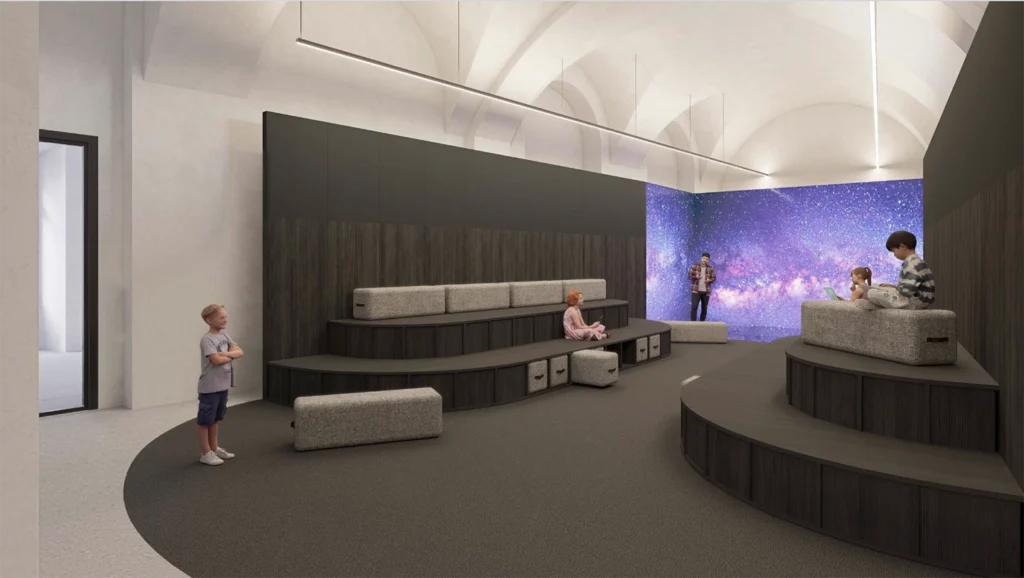
© mohr niklas architekten ZT GmbH: Visualisation 3D LED-CAVE
General information
Submission deadline stage 1
31.03.2026
Submission deadline stage 2
31.05.2026
Who can submit?
Researchers from the following institutions: Austrian Academy of Science, Technical University of Vienna, University of Vienna
What can be submitted?
Data visualisations, simulations, point clouds, 3D scans, ultra-high-resolution images, etc.
General questions
Email to calls@scicom.center
Submission
The call is organised as a two-stage process. Visualisation ideas for the first stage can be submitted until 31 March 2026. Selected projects will submit a detailed project description and a time and budget plan in a second stage by 31 May 2026.
To submit for the first stage, please fill out the the form with a short description of your project and send it together with your project outline to the following email address by the deadline: calls@scicom.center
If you are interested in presenting your research in this special format or are curious to find out whether your content is suitable for presentation in the CAVE, please do not hesitate to contact us. We are happy to advise you, particularly if you have questions about technical implementation or if the technical feasibility is still unclear. We offer two online information events for direct exchange.
Further information
How do I submit my ideas?
Fill out the form and send it together with your project outline to: calls@scicom.center.
Stage 1: What must my submission contain?
This call is a two-stage process.
Stage 1
The submission must include the following documents and represents the first stage of the selection process:
- Submission form
- Idea outline: a clear description of the plannedproject (max. two A4 pages)
- Type of data
- Type of presentation
- Sketches/illustrations/mood boards
Deadline for Stage 1: 31 March 2026
Applicants will be informed by the end of April whether their project has been selected for the second stage of the process.
Stage 2: What must my submission contain?
This call is a two-stage process.
Stage 2
For selected projects, a more detailed submission is required in a second stage. This additionally includes:
- Project description (max. four A4 pages)
- Time plan for the implementation of the project
- Budget for project development
- Where applicable, the names of cooperationpartners (e.g. artists, designers, software orhardware developers, companies, art universities, etc.)
Deadline for stage 2: 31 May 2026
The final selection will be made by the SCC by the end of June 2026 at the latest.
What funds are available for the development of visualisations in the CAVE?
Visualisierung im CAVE zur Verfügung?
A total of €200,000 is available for the implementation of selected projects. The total amount will be divided among several projects. The budget is primarily used to cover third-party costs incurred in the course of the technical and design preparation of the data submitted for the CAVE. For larger projects, it is also possible to apply for additional third-party funding together with the SCC. Do you have any questions about financing? Please feel free to contact us.
How is the content presented in the CAVE?
Selected projects are shown in the CAVE, where our mediators make them accessible to a wide audience.
The submitted data is presented in the CAVE in various formats:
- Short contributions (five to ten minutes) as part of the regular programme
- Special formats on selected research projects (30 minutes in length)
- Presentations by researchers (up to one hour)
Will I receive support with the submission?
Would you like feedback on your concept or are you looking for project partners to help you create content for the CAVE? Then get in touch with us as soon as possible and we will do our best to support you. We are also happy to coordinate an appointment with potential project partners. Please send an email to: calls@scicom.center
In addition, we invite you to attend the online information events on Wednesday, 4 March 2026, from 12:00 p.m. to 1:00 p.m. and on Monday, 16 March 2026, from 4:00 p.m. to 5:00 p.m. You will learn useful information about the submission process and have the opportunity to ask questions. Please register by clicking here:
What kind of content can be submitted?
Im Mittelpunkt des Calls stehen wissenschaftliche Daten, die im CAVE im Q. zu Zwecken der Wissenschaftskommunikation visualisiert werden. Zentrales Anliegen ist die öffentlichkeitstaugliche Aufbereitung von Forschungsprojekten und -ergebnissen, um Wissenschaft auf spannende, immersive und ungewöhnliche Weise erlebbar zu machen. Die mögliche Bandbreite an Visualisierungen ist dabei breit gefächert: Sie reicht von archäologischen und biologischen Datensätzen bis hin zu immersiven Darstellungen des Universums und von Kunstwerken bis hin zu Architekturprojekten, künstlerischen Arbeiten oder der Visualisierung sozialer Netzwerke.
If the submitted data is not initially technically suitable for display in the CAVE, we will adapt the content in consultation with the submitter so that a presentation is possible.
Who are the Scientific Advisors?
Univ.Prof. Mag.rer.nat. Dr.techn. Hannes Kaufmann, Technische Universität Wien
Univ.-Prof. Torsten Möller, PhD, Universität Wien
Univ.Prof. Dipl.-Ing. Dipl.-Ing. Dr.techn. Michael Wimmer, Technische Universität Wien